Amazon Published The Deadlines Before It Published The Dates.
Every binding date for Q4 is confirmed. Deal windows, inventory cutoffs, peak fees. What Amazon has not announced is when Prime Big Deal Days, Black Friday Week, or Cyber Monday actually run. So brands are being asked to commit stock and submit deals for events with no published dates. This guide covers what changed this year, what it costs, and the work that has to happen before each cutoff.
What Changed For 2026
The fees are the same as last year. Amazon held the peak increase at $0.32 per unit and did not add new eligibility requirements. The inventory deadlines moved up by 2 days, which is annoying but manageable. If those were the only changes, you could run last year's Q4 plan again with the dates shifted.
They are not the only changes. In May, Amazon replaced the AI that sits between shoppers and your products, and moved it into the main search bar. That is a bigger deal for Q4 than anything on the fee schedule.
Rufus is gone. Alexa for Shopping replaced it on May 13, 2026.
Rufus was a side panel most shoppers never opened. Alexa for Shopping sits inside the search bar and writes an AI summary above the results. It is the default for every signed-in US customer, with no Prime membership or Echo device required. It also shows 12 months of price history and runs side-by-side product comparisons inside the results page. Your listing is now the document an AI reads before it decides whether to recommend you.
Swipe to see all columns →
| What | Q4 2025 | Q4 2026 | So What |
|---|---|---|---|
| Peak fulfillment fee | +$0.32 per unit, Oct 15 to Jan 14 | +$0.32 per unit, Oct 15 to Jan 14 | Same increase. But the 3.5% fuel surcharge started in April 2026 and now stacks on top of it. |
| Black Friday inventory cutoff | October 30, 2025 | October 28, 2026 | 2 days earlier. Book the delivery appointment 7 days before that, so you are really working to October 21. |
| AI shopping layer | Rufus, an optional side panel | Alexa for Shopping, in the search bar | Every signed-in US shopper now gets an AI summary above the results, whether they asked for one or not. |
| Event dates | Prime Big Deal Days confirmed for Oct 7 to 8 | No dates confirmed as of Aug 10 | You commit stock to a September 16 cutoff for an event Amazon has not dated. A spokesperson declined to confirm even the likely week. |
| Average cost per click, full year | Around $1.12 | $1.18 to $1.22 | Up 8% to 12%. Sponsored Display rose about 49%, to roughly $3.72. |
| Cost per click in November | Around $1.46 | Around $1.56 | Q4 runs about 30% above whatever that year's average is. The seasonal premium is not new. It applied in 2025 too. What changed is the base it sits on top of. |
| AWD storage pricing | Standard transition to peak rates | Off-peak rate held to October 31 | Only if you use AWD with automatic replenishment into FBA. Worth checking whether that changes your storage mix. |
| Competitive benchmarks | US only | 18 markets, live since May 18 | You can now compare impressions, click-through rate, ROAS, and ACoS against category peers instead of guessing. |
The peak fee and the surcharge are the two that hit your P&L directly. Both apply to every unit that ships after October 15, and the fee is charged when the unit leaves the fulfillment center, not when it arrives. So a unit you sent in September at off-peak rates still ships at peak rates in November. Price your deals accordingly.
The Q4 2026 Deadline Calendar
These are arrival deadlines, not ship-by dates.
Your inventory has to be physically at Amazon by the date listed. Carrier transit and Amazon's receiving process both happen before that. Amazon recommends booking your delivery appointment at least 7 days ahead, and during Q4 it routinely pushes requested appointments several days later than you asked for. Work backward from the arrival date, not forward from the day you ship.
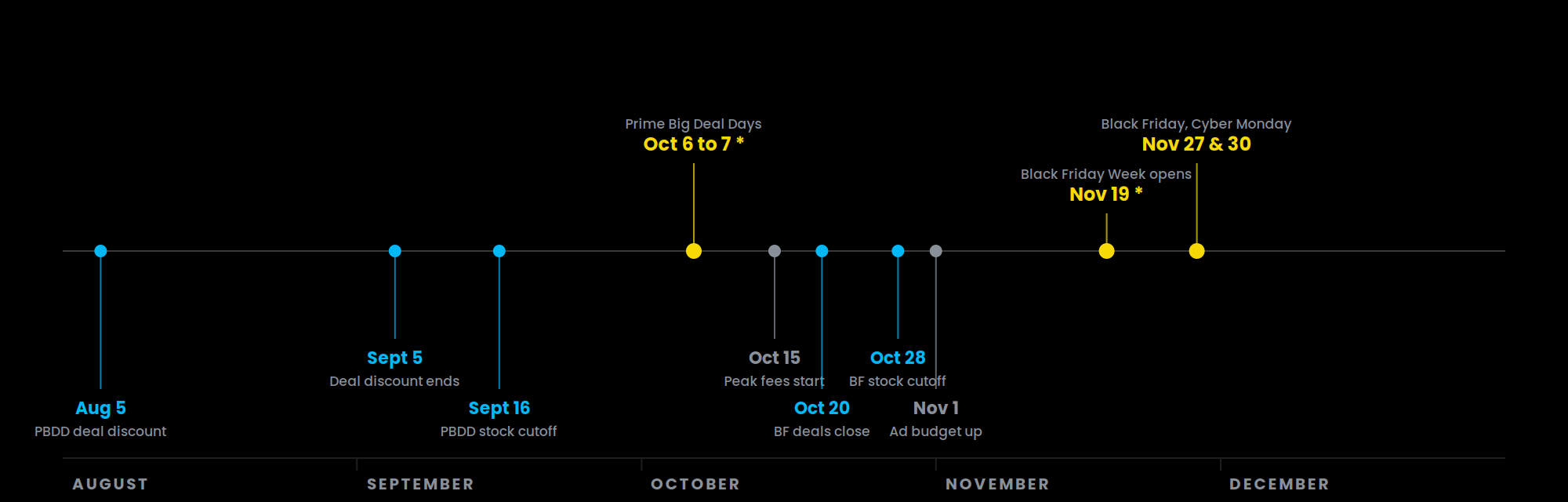
Swipe to see all columns →
| Date | Type | What Happens | Finish This First |
|---|---|---|---|
| Aug 5 | Deadline | Prime Big Deal Days early submission discount closes | SKU selection, margin model including peak fees, deal eligibility check |
| Sept 2 | Stock | Prime Big Deal Days arrival, AWD | POs placed, freight booked |
| Sept 5 | Deadline | Black Friday and Cyber Monday early submission discount closes. Saves $50 per deal on the upfront promotion fee | Deal SKU list finalized, prices set against the 30-day and 60-day lookback |
| Sept 8 | Deadline | Prime Big Deal Days deal submission window closes | Final deals entered in Seller Central |
| Sept 9 | Stock | Prime Big Deal Days arrival, FBA minimal splits | Delivery appointments booked by Sept 2 |
| Sept 16 | Stock | Prime Big Deal Days arrival, FBA Amazon-optimized splits. Most sellers use this option | Listing refresh complete, delivery appointments booked by Sept 9 |
| Oct 6 to 7 * | Event | Prime Big Deal Days runs | Ads live, monitoring rota staffed, Buy Box alerts on |
| Oct 14 | Stock | Black Friday and Cyber Monday arrival, AWD | Second inbound wave dispatched |
| Oct 15 | Fees | Peak fulfillment fees start. +$0.32 average per unit plus 3.5%, running through January 14, 2027 | Repricing rules updated, break-even ACoS recalculated at the new landed cost |
| Oct 20 | Deadline | Black Friday and Cyber Monday deal submission window closes | Any remaining deals submitted at the full $100 upfront fee |
| Oct 21 | Stock | Black Friday and Cyber Monday arrival, FBA minimal splits | Delivery appointments booked by Oct 14 |
| Oct 28 | Stock | Black Friday and Cyber Monday arrival, FBA Amazon-optimized splits | Capacity limits confirmed, appointments booked by Oct 21 |
| Oct 31 | Fees | Off-peak storage rate ends for AWD sellers using automatic replenishment | Storage mix decided between AWD and FBA |
| Nov 1 | Budget | Ad budgets step up, peaking through Thanksgiving week | Last November's search term report reviewed, budget set campaign by campaign |
| Nov 19 * | Event | Black Friday Week likely opens | Pricing health clean, DSP retargeting pool built, escalation owner named |
| Nov 26 | Event | Thanksgiving | Daily monitoring live through the weekend |
| Nov 27 | Event | Black Friday | Budgets pre-funded so campaigns do not run dry by midday |
| Nov 30 | Event | Cyber Monday | Replenishment triggers set for the December run-in |
| Dec 23 to 24 * | Event | Last delivery dates before Christmas. Varies by shipping speed and region | Gift-intent creative live, FBM backup ready |
| Jan 14, 2027 | Fees | Peak fulfillment fees end. Rates revert January 15 | Post-season removal and aged inventory plan ready |
* Estimated. Amazon has confirmed every deadline and fee date above, but has not published its 2026 event dates. Thanksgiving, Black Friday, and Cyber Monday are fixed by the calendar and certain. The rest are our projections from the 2025 schedule. Use them for planning, not for anything contractual.
Deal fees carry over from Prime Day: $100 upfront per promotion, plus 1.5% of promotional sales capped at $5,000. Prime Big Deal Days prices are excluded from the 30-day and 60-day lookback windows, so an October discount does not cap what you can charge in November.
Listings Have To Start First
Amazon re-indexes keyword changes within 24 to 72 hours. Organic rank takes weeks to catch up. That gap is why listing work has to be finished before the inventory arrives, not after. A listing rewritten in November earns its rank in December, which is after the revenue it was meant to capture.
Two systems read your listing now. Keyword search still runs underneath, and keyword relevance still decides which queries you can appear for at all. On top of it, Alexa for Shopping reads the whole listing, including images, attributes, reviews, and Q&A, then writes a summary and a comparison for a shopper who may never scroll the results.
Agencies tracking ranking through 2026 report the same direction of travel: conversion rate carries more weight than raw sales volume, and how often a click from a specific query ends in a purchase matters more than how many times the keyword appears. A listing that converts well beats one that mentions the term more often. Traffic from Google, social, and influencers that converts on Amazon gets credited as proof of real demand.
Fill In Every Attribute
Discovery attributes in your product template, like subject, target audience, and intended use, feed how Amazon categorizes and surfaces your listing. Audit these against your top 3 competitors before September. Include the fields Amazon marks optional.
Write Answers, Not Keyword Lists
Bullets that lead with a feature and what it does for the shopper give the assistant something to quote. A+ Content that reads as information rather than a sales pitch gets used more. Write for the question a shopper would ask out loud.
Keep Reviews Coming
Review quality and recency both feed AI recommendation. A strong review base from 2024 counts for less than a steady flow through 2026. Vine enrollment and follow-up sequences take weeks to produce volume, so start now.
- Pull the search term report from the same period last year and compare it against what your listings currently target. The words shoppers use move faster than most catalogs get updated.
- Complete every attribute field on your top 20 revenue ASINs.
- Test conversational queries. Ask Alexa for Shopping the questions a shopper in your category would ask. Write down whether your products come up and how they get described.
- Fix conversion before you add keywords. Check Unit Session Percentage in Business Reports weekly. A listing with weak conversion will not hold the rank it gains from indexing.
Expect 30 to 60 days of noisy numbers
Agencies report a 30 to 60 day period where ACoS, TACoS, and new-to-brand rate look unstable as the new discovery layer rolls out. Read November performance with that in mind rather than comparing it straight to last year.
Advertising, Promotions, And Pricing
Amazon ad costs have gone up every year for 6 years running. In 2026 the blended average sits between $1.18 and $1.22 per click, up 8% to 12% on last year and more than 60% since 2020. Sponsored Display rose fastest, up roughly 49% to around $3.72, as more sellers adopted it and Amazon opened more placements across its own sites and its off-Amazon publisher network.
Two separate numbers matter here, and they get confused constantly. The 8% to 12% is the year-over-year increase: what a click costs in 2026 against what the same click cost in 2025. The 30% is the seasonal premium: what a click costs in Q4 against the 2026 annual average. They are not the same thing and they do not stack into 40%.
The seasonal premium is not new. It applied in 2025 and 2024 as well. What changed is the base it sits on top of. In practical terms: if your 2026 blended CPC is $1.20, budget November around $1.55, not $1.20. And if you carried last November's budget forward unchanged, it buys roughly 10% fewer clicks this year before the seasonal premium is even applied.
Costs climb through September, jump during Prime Big Deal Days, and peak in Thanksgiving week. Gifting categories like toys and electronics run higher than the blended average.
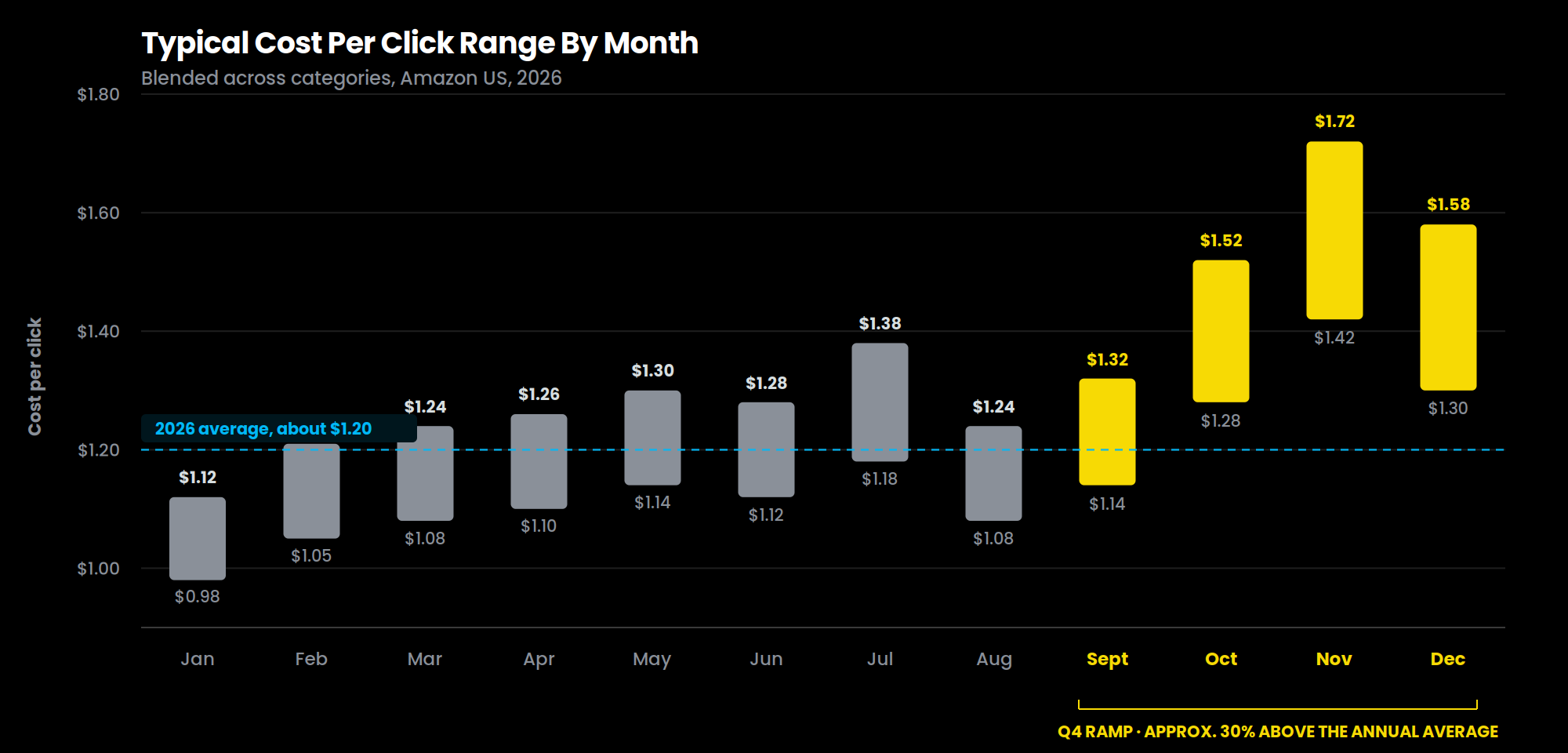
Modeled ranges, not measured monthly figures. Built from published 2026 benchmark averages and reported seasonal multipliers. Outlier categories excluded. Use this to shape a budget curve, then verify against your own account history.
One reported example: a brand cut the campaigns it had flagged as wasteful. Cost per click fell 18% and advertising cost of sales fell 12%. Total revenue fell 31%. The campaigns it removed were holding impression share in adjacent search results where organic rank was too weak to make up the difference. The efficiency metrics improved while the business shrank.
Reprice Against The New Landed Cost
Peak fees and the 3.5% surcharge change break-even ACoS for every FBA unit shipped after October 15. Download the fee report, add the peak increase per SKU type, and update your bid ceilings and floor prices before you set November budgets.
Use The Category Benchmarks
Amazon made competitive benchmarks generally available across 18 markets on May 18, 2026, covering impressions, click-through rate, ROAS, and ACoS. Check the category before you decide a campaign is underperforming. Sometimes the whole category moved.
Check Which Attribution Window You Are Reading
Sponsored Products attributes click-based sales within 7 days for sellers and 14 days for vendors. Sponsored Brands and Sponsored Display both use 14 days. The same campaign looks better or worse depending on the window.
Price The Deal Against November Costs
A promotional price set in August against August fulfillment costs will lose money in November, because the unit ships at the peak rate. Build the peak fee and the surcharge into the margin before you submit.
- Pull last November's search term report. Find which terms converted, which campaigns spent without converting, and which ASINs produced the most revenue.
- Separate gift-intent terms from evergreen terms. They behave differently and often justify a higher bid for a narrow window.
- Set budgets campaign by campaign. A single account-level increase funds whichever campaigns already spend fastest, and those are often the least efficient ones.
- Fund the peak weeks in advance. Budget caps bite hardest on the highest-traffic days. A campaign that runs dry at noon on Black Friday gives up the afternoon.
DSP Needs A Longer Runway Than Sponsored Ads
Sponsored Products buys clicks from people already searching for what you sell. Amazon DSP buys impressions from people who have not started searching yet. It runs on CPM rather than CPC, and it reaches audiences on Amazon properties and across the wider web, including Fire TV, Twitch, and Amazon's publisher network.
That difference matters for timing. A Sponsored Products campaign can be turned up on November 1 and produce sales that week. A DSP campaign built on November 1 spends most of November learning. The audiences that convert during Black Friday week are the ones you started building in September, from people who viewed a product, added to cart, or bought in your category earlier in the season.
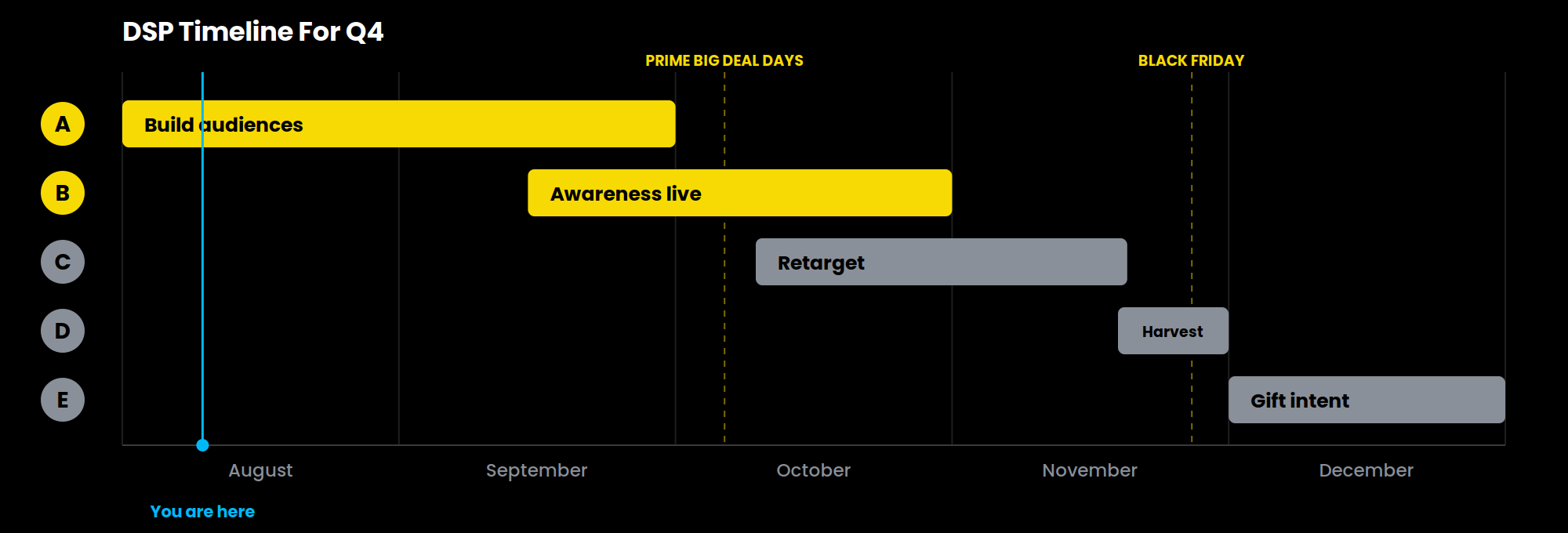
Swipe to see all columns →
| Phase | Window | What It Involves | |
|---|---|---|---|
| A | Build audiences | Aug to Sept 30 | Confirm pixels and audience segments are live. Run AMC queries against last Q4 to see the real path to purchase in your category, then build segments from what you find. Writing and validating those queries is the slow part. |
| B | Awareness live | Sept 15 to Oct 31 | Upper-funnel campaigns running before Prime Big Deal Days, so the October event feeds your retargeting pool instead of passing through it. Running awareness and retargeting in the same week costs more and works less well. |
| C | Retarget the October pool | Oct 10 to Nov 20 | Retarget everyone who viewed, added to cart, or bought in category during Prime Big Deal Days. This pool is the most valuable Black Friday audience you will have, and it only exists if A and B happened. |
| D | Harvest | Black Friday week | Concentrate spend on the warmest segments. This is the week to collect, not the week to prospect. Judge it on total advertising cost of sale across the business, since DSP shows up in total revenue before it shows up in attributed revenue. |
| E | Gift intent and January | December | Shift creative toward gifting and last-minute delivery messaging. Start building the January remarketing pool from everyone who engaged during the season and did not convert. |
Event markers use the estimated 2026 dates from Section 02. A and B are the phases that cannot be compressed. A Sponsored Products campaign can be turned up on November 1 and produce sales that week. A DSP campaign built on November 1 spends most of November learning.
Defend Your Brand Terms
DSP awareness drives people to search your brand name on Amazon. If you are not covering branded search, a competitor bidding on your name intercepts that traffic. Branded coverage runs alongside DSP, not after it.
Separate The Budgets
Ranking, performance, research, and brand defense each have a different job and need a different budget cap. Mixing DSP into a single pooled budget makes attribution impossible and lets the fastest-spending line item absorb the rest.
Judge It On TACoS
DSP shows up in total revenue before it shows up in attributed revenue, so ACoS will look poor in isolation. Total advertising cost of sale across the business is the number that reflects what DSP is actually doing.
Staying Available And Owning The Buy Box
Four things can take your product off the page during an event week: you run out of stock, a reseller takes the Buy Box, your price falls out of line with the rest of the market, or Amazon suppresses the listing. All 4 produce the same result. Traffic arrives and cannot buy from you. Each one needs a different plan, and all 4 plans have to exist before the traffic shows up.
1. Stockouts
Sales velocity is one of the strongest inputs to organic rank. When stock hits zero, velocity hits zero, and Amazon reads that as a product that stopped converting. A gap of 1 to 2 days where you keep the Buy Box barely registers. Longer gaps produce real rank loss.
Reported numbers vary by source and category. A 7-day stockout has been reported to cut ranking by 30% to 50%. Recovery estimates cluster between 3 and 8 weeks of consistent availability, with some sources putting the minimum at 21 to 28 days of steady performance. Sellers rebuilding rank commonly report needing 30 to 60 days of elevated ad spend, which means the stockout keeps costing you after the stock comes back.
Swipe to see all columns →
| Cost | When You See It |
|---|---|
| Lost sales during the gap | Immediately. This is the only one most P&Ls capture. |
| Rank decay | Within 3 to 5 days. Your position goes to competitors who are in stock. |
| Recovery advertising | 30 to 60 days after restock, at higher ACoS, buying back a position you used to hold for free. |
| Subscribe and Save cancellations | At the next scheduled delivery. Those orders do not come back on their own. |
| Review gap | 2 to 6 weeks later, when the reviews from units you never sold fail to arrive. |
Receiving times
A shipment that gets checked in within 3 to 7 business days in August can take 10 to 21 days or longer during peak. Congested appointment calendars cause most of it, not carrier delays. Amazon has stated it cannot manually expedite receiving, so the buffer has to be in your plan rather than in a support case.
2. Unauthorized Resellers And The Buy Box
A third-party seller listing against your ASIN at a lower price can take the Buy Box from you on your own product. During a deal week that means your promotion drives traffic to a page where someone else collects the sale, usually at a price that undercuts the deal you paid to run. It also breaks your deal, because deals require you to hold the Buy Box.
Audit The Offer Listings Now
Check every revenue ASIN for other sellers on the listing. Do this in August, when you still have time to act, rather than during Black Friday week when enforcement takes longer than the event lasts.
Use Brand Registry And Transparency
Brand Registry gives you the reporting tools. Transparency and Project Zero give you the enforcement. Enrollment and setup take weeks, so this is September work at the latest.
Tighten Distribution Before The Season
Most unauthorized offers trace back to a distributor or a wholesale account. Reseller policies and MAP agreements are slow tools, which is why they need to be in place before Q4 rather than enforced during it.
Monitor Daily During Event Weeks
Set alerts for new sellers on your ASINs and for Buy Box changes. A reseller who appears on Black Friday morning and goes unnoticed until Monday has taken the whole weekend.
3. Pricing Alignment
Amazon compares your price to what the same product sells for elsewhere. If your product is cheaper on your own site, at a big-box retailer, or on another marketplace, Amazon can remove the Buy Box entirely. The listing stays up. The buy button goes away. Shoppers see "See All Buying Options" instead of "Add to Cart," and conversion collapses.
This becomes far more likely in Q4, because that is exactly when every other channel is running its own promotions. A retail partner discounting to match Black Friday can knock you out of the Buy Box on Amazon without either of you noticing.
- List every channel that sells your product and get their Q4 promotional calendars in writing.
- Compare planned Amazon deal prices against those calendars and find the conflicts now, while you can still change your deal submission.
- Set repricer floors above your break-even at the new peak landed cost, including the $0.32 and the 3.5%.
- Watch the Pricing Health dashboard daily through November. It flags the ASINs where Amazon has found a cheaper price elsewhere.
- Remember Alexa for Shopping now shows 12 months of price history to shoppers directly. Inconsistent pricing is more visible this year than it has ever been.
4. Suppression
A suppressed listing produces the same signal as a stockout, and the causes are usually boring and fixable: a missing image, a title that breaks category rules, an incomplete required attribute, a compliance document that expired, or a category-specific safety requirement nobody checked. Fixing one in August takes an afternoon. Fixing one during Cyber Monday takes a support case and several days you do not have.
Run A Full Listing Health Sweep In September
Check Fix Your Products, stranded inventory, and the suppressed listings report across the whole catalog, not just the deal SKUs. Clear every flag before the first inventory deadline.
Confirm Compliance Documents Are Current
Safety certificates, ingredient documentation, and category approvals expire. Check the expiry dates against the whole Q4 window, not against today.
Watch Account Health Through The Season
Order defect rate, late shipment rate, and policy violations all feed visibility. Peak volume makes these metrics move faster than they do the rest of the year.
Know Who Fixes It At 9pm On Black Friday
Name the person, agree the escalation path, and confirm they have Seller Central access before the weekend. Discovering a permissions gap mid-event costs hours.
- Book delivery appointments at least 7 days before each arrival deadline. Amazon recommends this directly and routinely pushes Q4 appointments later than requested.
- Deliver mid-window rather than on the last day. If your window runs October 21 to 27, aim for the 23rd.
- Check November capacity limits in Capacity Monitor and request more space through Capacity Manager before September.
- Keep a small merchant-fulfilled buffer on your top revenue ASINs. It keeps the listing live and holds some velocity if FBA stock runs out mid-event.
- Pack deal inventory in separate, clearly labeled boxes so those SKUs are not stuck behind general replenishment in receiving.
- Monitor Buy Box status, pricing health, and suppressions daily through the event weeks. One dashboard, one owner, every morning.
Your Competitors Are Submitting Right Now
The deal window opened July 8 and closes October 20. Everyone in your category is inside it this month. And most of what they are planning is visible from the outside before the event runs.
Deal participation, price history, listing changes, and review velocity are all public. Alexa for Shopping now shows 12 months of price history directly in the shopping interface, which makes competitor pricing patterns easier to read this year than last. A weekly review through September and October gives you a usable picture of what the top sellers in your category are preparing.
Deal Participation
Track which competitor ASINs carry deal badges during Prime Big Deal Days. October participation is a reliable signal of November intent, and it tells you their price floor.
Price History
Deal prices are constrained by the 30-day and 60-day lookback. A competitor cutting price in September is capping what they can discount in November.
Listing Changes
Title, image, and A+ Content changes in September mean a brand is preparing for the season. The same changes in November mean they are reacting to it.
Review Velocity
A sharp jump in review volume usually comes before a launch or a deal push. Track weekly counts on the top 5 ASINs in your main category.
New Entrants
The competitive set in most categories changes between one Q4 and the next. Rebuild the competitor list in September instead of reusing last year's.
Category Benchmarks
Amazon's own benchmark report gives category-level impressions, click-through rate, ROAS, and ACoS. Use it to tell a campaign problem apart from a category-wide shift.
7 Questions To Answer Before September 5
Each one maps to a deadline in Section 02. If you cannot answer it today, that is work that has not started yet.
- Which SKUs are you submitting for Black Friday and Cyber Monday, and is the deal price modeled against peak fulfillment fees rather than today's fees?
- When did you last refresh your listings against the search terms shoppers are using now, and have you checked how your products come up in Alexa for Shopping?
- Have you pulled last November's search term report and found which terms converted, which campaigns wasted spend, and which ASINs produced the most revenue?
- Is your November ad budget set campaign by campaign, funded in advance, and built on a Q4 cost per click roughly 30% above your annual average?
- Are your DSP audiences and pixels live now, so the October event builds a retargeting pool instead of passing through it?
- Who owns Buy Box status, pricing health, and suppressions during the event weeks, and are they checking daily?
- Do you know what the top 5 sellers in your category did during Prime Big Deal Days, and what their price history says about their November floor?
A brand that cannot answer 4 of these on August 10 has about 4 weeks to close the gap before the first deadline that costs money.
We Are Building Q4 Plans Right Now.
We manage Amazon for brands across a range of categories, and this calendar is the one we are working to. If you want to see what a Q4 plan looks like for your catalog, including the deal SKU list, the budget model, the DSP timeline, and the inventory schedule, we will build it and walk you through it.
Let's TalkSources And How Confident We Are
Every claim is scored against 3 tests: does the source name real results, does the person writing it describe doing the work, and is the underlying data published. All 3 is HIGH. Two is MEDIUM. One is LOW.
Swipe to see all columns →
| Claim | Score | Where It Comes From |
|---|---|---|
| Peak fees Oct 15 to Jan 14, +$0.32 average per unit, plus 3.5% surcharge | High | Amazon Seller Central announcement, confirmed by Supply Chain Dive, Chain Store Age, and EcommerceBytes. |
| Deal windows and the $50 early submission discount at Aug 5 and Sept 5 | High | Amazon Seller Central, quoted directly by EcommerceBytes, PPC Land, and Chain Store Age. |
| Inventory arrival deadlines: Sept 2 / 9 / 16 and Oct 14 / 21 / 28 | High | Amazon Seller Central. The 2025 comparison date of Oct 30 comes from the 2025 forum announcement. |
| Base FBA fulfillment fees run from $3.06 to over $11.00 per unit | High | Published 2026 rate tables verified against the Seller Central fee schedule. This is what the 3% to 10% range on the peak fee is calculated from. |
| Rufus retired May 13, 2026, replaced by Alexa for Shopping in the search bar | High | Amazon announcement, reported independently by 6 agencies with dated first-hand accounts of the interface change. |
| Average CPC $1.18 to $1.22 in 2026, up 8% to 12%; Sponsored Display up about 49% | High | Ad Badger's published client dataset and Epinium's 2026 benchmark report. Both publish method and a monthly series. |
| Q4 CPC runs roughly 30% above the annual average | Medium | Epinium benchmark, cited by 2 agencies. Named figure and published dataset, but the seasonal multiplier has not been independently replicated. |
| Monthly CPC ranges in the chart | Medium | Modeled, not measured. Built from the published annual averages, the reported Oct 2025 low and May 2026 high, and reported seasonal multipliers. Directional. |
| Stockout recovery takes 3 to 8 weeks; recovery ad spend runs 30 to 60 days | Medium | Several practitioner accounts with named figures. Ranges differ by source and category and nobody publishes a full sample. Treat as a planning range. |
| Peak receiving of 10 to 21 days against 3 to 7 days off-peak | Medium | Consistent first-hand reports from prep centers, freight forwarders, and seller support specialists. Self-reported, so the real distribution is unknown. |
| 2026 event dates | Estimate | Amazon has published nothing beyond "the same time as last year" for Prime Big Deal Days and declined to confirm specific dates. Estimates are built from the 2025 schedule and the fixed 2026 calendar. |
| Conversion rate weighted above raw sales volume in organic rank | Low | Directionally consistent across several agency sources and in line with Amazon's stated direction, but nobody has published a controlled test. Evidence is thin. Treat it as a working assumption. |
Where practitioners disagree. Stockout recovery time is the widest gap in the evidence. Reported ranges run from 1 to 2 weeks for a short gap on a slow SKU, up to 60 to 90 days for a 30-day gap on a mature ASIN. What reconciles them is sales velocity. A fast-moving SKU sends a louder signal when it goes quiet, so it falls further and takes longer to climb back.
What nobody knows yet. Amazon has not announced the 2026 dates for Prime Big Deal Days, Black Friday Week, or Cyber Monday. Nobody has published measured results on how Alexa for Shopping changes advertising performance either, because it launched in May and the first full peak season under it has not happened. This Q4 is the test.